Our History
A Journey of People, Programs, and Possibilities
Mission Hope Foundation's history is a story of growth, adaptation, and service. What began as a small educational initiative in Mississippi developed across several states and communities, serving young people, individuals experiencing incarceration and reentry, religious organizations, and communities facing a variety of needs. The organization did not begin as a workforce-development organization, nor did each program replace the one before it. Instead, each chapter added experience that helped shape the organization Mission Hope Foundation is today.
1998: Where the Journey Began
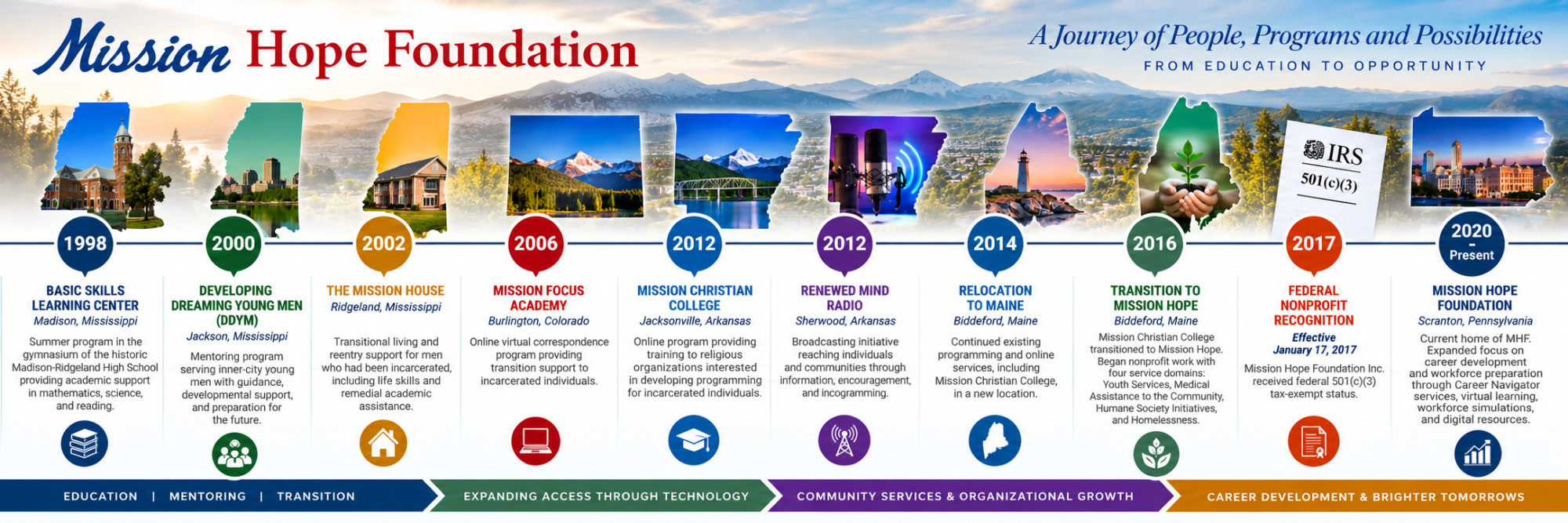
The earliest roots of what would eventually become Mission Hope Foundation began in 1998 with the Basic Skills Learning Center in Madison, Mississippi. The summer program operated in the gymnasium of the historic Madison-Ridgeland High School and provided young people with additional educational opportunities outside the traditional school year. Programming focused on strengthening foundational academic skills in mathematics, science, and reading. This initiative established an early commitment to creating educational opportunities for young people.
The Basic Skills Learning Center initially concentrated on academics, but the work with young people gradually expanded beyond classroom instruction. Education provided an entry point for recognizing the importance of mentoring, guidance, and broader developmental support. These experiences contributed to the expansion of programming beyond traditional academic enrichment. In 2000, that work grew to include Developing Dreaming Young Men.
2000-2001: The Evolution of DDYM
In 2000, Developing Dreaming Young Men (DDYM) began in Jackson, Mississippi, as a mentoring program serving inner-city young men. The program expanded the organization's work beyond academic assistance by providing mentoring, developmental support, and preparation for the future. As the program grew, its reach expanded beyond its original population. This growth created an opportunity to develop programming that could serve young women as well.
In 2001, Developing Dreaming Young Women (DDYW) was introduced to extend the program's mentoring and developmental approach to young women. During the same year, the broader program officially adopted Developing Dreaming Young Minds (DDYM) as the meaning of the DDYM acronym. The change allowed the established DDYM identity to continue while representing programming designed to serve young people more inclusively. Developing Dreaming Young Minds would remain an important part of the organization's youth-development history as the broader work continued to evolve.
In 2002, The Mission House was established in Ridgeland, Mississippi, as a transitional house for men who had previously been incarcerated. The program supported individuals navigating reentry by providing an environment focused on developing skills needed for successful transition into community life. Programming included transitional living skills and remedial academic assistance, continuing the educational foundation established through earlier initiatives. The Mission House expanded the work into a new population while maintaining an emphasis on education, development, and transition.
The Mission House added reentry and transitional living to the organization's growing experience. Participants needed more than academic assistance as they prepared to navigate responsibilities and expectations following incarceration. Practical preparation therefore became an important complement to educational support. These experiences would later contribute to additional programming involving incarcerated and justice-involved individuals.
2006: Mission Focus Academy
In 2006, Mission Focus Academy operated in Burlington, Colorado, as a mail-in correspondence school providing educational and transition support to incarcerated individuals. Participants completed educational materials through a correspondence-based model rather than through virtual or online instruction. This approach allowed programming to reach individuals within correctional environments where access to traditional educational settings could be limited. Mission Focus Academy represented an important expansion of the organization's experience in correctional education and transition support.
The correspondence model demonstrated that educational programming could be delivered beyond a traditional classroom while still providing structured learning opportunities. Printed materials could be distributed, completed, and returned through the mail, allowing participants to engage with programming despite the restrictions of a correctional environment. This experience expanded the organization's understanding of alternative methods for providing education and transition support. The organization's move into online education would come later with Mission Christian College.
2012: Mission Christian College and Renewed Mind Radio
In 2012, Mission Christian College operated from Jacksonville, Arkansas, as an online educational program providing training to religious organizations interested in developing programming for incarcerated individuals. The initiative expanded the organization's approach from providing direct services to also helping other organizations prepare to serve correctional populations. Online delivery allowed the training to extend beyond a single physical location. Mission Christian College continued the organization's growing use of education and technology as tools for expanding access.
Also in 2012, Renewed Mind Radio began in Sherwood, Arkansas, adding broadcasting to the organization's developing methods of outreach. The radio initiative represented another use of technology alongside the online educational work occurring during the same period. Together, Mission Christian College and Renewed Mind Radio expanded the ways programming and information could be delivered beyond traditional face-to-face settings. This period further demonstrated the organization's willingness to explore different methods of connecting education, service, and technology.
2014: A New Chapter in Maine
In 2014, the work relocated to Biddeford, Maine, beginning another stage in its geographic and organizational development. Mission Christian College continued operating through its online model following the relocation, allowing programming to continue despite the move to a new state. The Maine period carried forward experience in education, correctional programming, transition support, distance learning, and community outreach. It also became the setting for an important transformation in the organization's identity.
By this period, the scope of the work extended beyond what had originally been represented by the Mission Christian College name. Years of programming across Mississippi, Colorado, Arkansas, and Maine had involved different populations, needs, and methods of service delivery. The organization had accumulated experience in education, mentoring, reentry, transition, online programming, training, and outreach. In 2016, that continuing evolution resulted in a new organizational identity and a broader nonprofit service model.
2016: The Transition to Mission Hope
In 2016, Mission Christian College transitioned to Mission Hope as the organization began operating under a broader nonprofit service model. The new identity expanded the organization's work beyond its previous educational and correctional-programming focus. Mission Hope organized its nonprofit activities around four service domains: Youth Services, Medical Assistance to the Community, Humane Society Initiatives, and Homelessness. Donated supplies and community assistance became important parts of the organization's service activities during this period.
The transition to Mission Hope represented more than a change in name. The organization was broadening its service model to address several areas of community need rather than concentrating primarily on one educational program or population. This period allowed Mission Hope to apply its experience in education, outreach, transition, and service within a wider community context. It also established the Mission Hope identity that would continue developing into Mission Hope Foundation.
2017: Federal Nonprofit Recognition
In 2017, Mission Hope Foundation Inc. received federal recognition as a tax-exempt organization under Section 501(c)(3) of the Internal Revenue Code, with an effective exemption date of January 17, 2017. The recognition formally established the organization's federal tax-exempt status and provided a nonprofit structure for continuing the community-focused work developed under the Mission Hope name. This milestone represented an important legal and organizational development in a service history that had already been evolving for nearly two decades. It marked the formal recognition of another stage in the organization's development rather than the beginning of its work.
By this point, the organization's history included academic enrichment, mentoring, transitional living, reentry assistance, correctional programming, virtual education, organizational training, broadcasting, and community service. These initiatives had not been created as parts of a predetermined workforce-development plan. Each reflected the populations, circumstances, and needs encountered during a particular period of the organization's history. Collectively, however, they created substantial organizational experience in education, access, development, and transition.
2020–Present: Mission Hope Foundation in Scranton, Pennsylvania
In 2020, Mission Hope Foundation established its current operations in Scranton, Pennsylvania, beginning the organization's present era. Building upon more than two decades of educational and community-service experience, MHF increasingly concentrated its work on career development and workforce preparation. The organization brought together its experience with education, transition, technology, youth programming, and alternative methods of program delivery to help young people prepare for movement from education into employment. This development represents the organization's current direction while remaining connected to the experiences that preceded it.
Today, Mission Hope Foundation provides career-development programming designed to help participants build skills, confidence, and practical knowledge related to employment. Its work includes Career Navigator services, virtual learning, workforce simulations, digital learning resources, and other career-development experiences. Participants can receive support in areas such as employment applications, interviewing, organizational entry, professional communication, workplace expectations, feedback, and performance. Simulation-based programming extends this approach by providing opportunities to practice selected employment experiences before encountering similar situations in actual workplaces.
Building on the Past. Preparing for Brighter Tomorrows.
Mission Hope Foundation's journey began with a summer academic program in Mississippi and has continued across multiple states, populations, and forms of service. Its history includes education, mentoring, reentry, transitional living, correctional programming, virtual learning, training, broadcasting, community assistance, career development, and workforce preparation. Each stage reflects the circumstances and needs of its time, while collectively demonstrating an organization willing to learn, adapt, and continue moving forward. The Mission Hope Foundation of today is therefore not a departure from its history, but the latest chapter in an organization that has continually evolved through service.
As Mission Hope Foundation looks toward the future, its focus is on expanding access to high-quality career-development and workforce-preparation programming regardless of geography, community, or economic circumstances. Technology, simulation, experiential learning, digital resources, and accessible programming provide new opportunities to reach individuals who may otherwise face barriers to quality career preparation. MHF seeks to help participants move beyond simply learning what happens in the employment process by providing opportunities to experience and practice how to navigate it. The programs have changed since 1998, but the commitment to creating opportunities for people to learn, develop, transition, and move toward brighter tomorrows continues.